
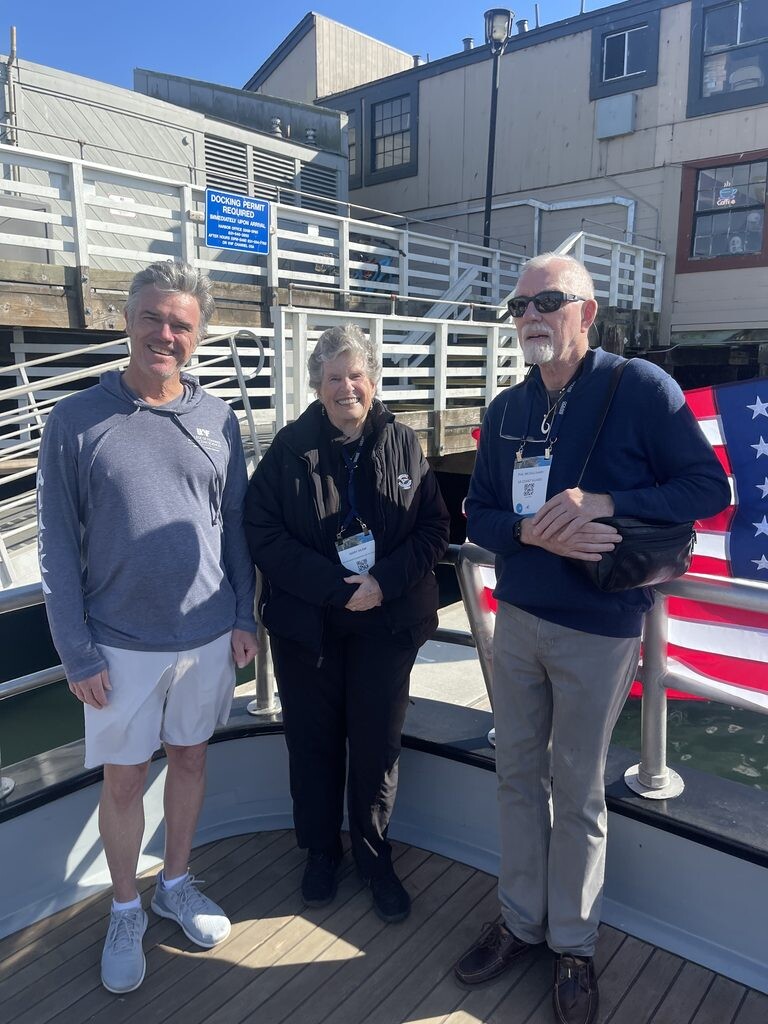
Last week, we participated in OCEANS 2026 in Monterey, an international conference for ocean science and technology, and welcomed attendees from around the world aboard the Western Flyer.
Among our visitors was Mary Munk, president of the Walter Munk Foundation for the Oceans and widow of renowned Scripps oceanographer Walter Munk.
While aboard, Mary shared a fascinating connection: Walter Munk and John Steinbeck had once gone to sea together.
That sent us looking more closely at the story of another remarkable voyage of scientific discovery.
Another expedition, 21 years later
In the spring of 1961, more than two decades after the Folleto occidental voyage to the Gulf of California, Steinbeck found himself aboard another vessel off the coast of Mexico.
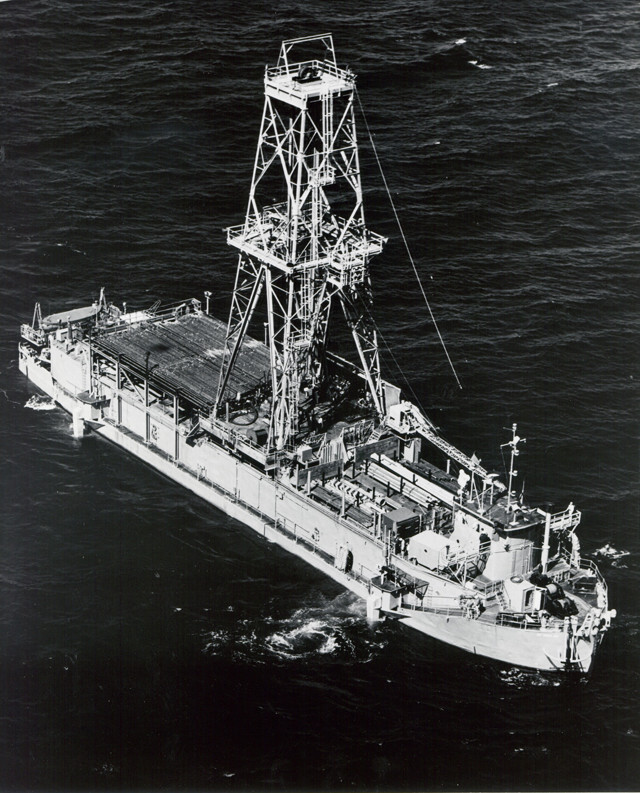
This time, the vessel was CUSS I, and the expedition was Project Mohole, one of the most ambitious earth-science projects of its era.
CUSS I was not exactly an elegant research vessel. Steinbeck described it as having “the sleek race lines of an outhouse standing on a garbage scow.”
Among the scientists aboard were Walter Munk and Roger Revelle of Scripps Institution of Oceanography.
Project Mohole grew from a wonderfully audacious idea: while humans were looking toward space, another vast frontier remained largely unexplored beneath the ocean floor.
The ultimate goal was to drill through the Earth’s crust to the Mohorovičić discontinuity, or “Moho,” the boundary between the crust and mantle.
The 1961 expedition off Guadalupe Island was designed to test whether drilling into the seafloor from a vessel in very deep water was possible. Working in 11,700 feet of water, CUSS I used a pioneering dynamic-positioning system, relying on acoustic signals and four large outboard motors to maintain its position rather than anchoring to the seafloor. The team drilled as deep as 601 feet beneath the ocean floor and recovered basalt.
It was a remarkable technical achievement. And Steinbeck was there to tell the story.
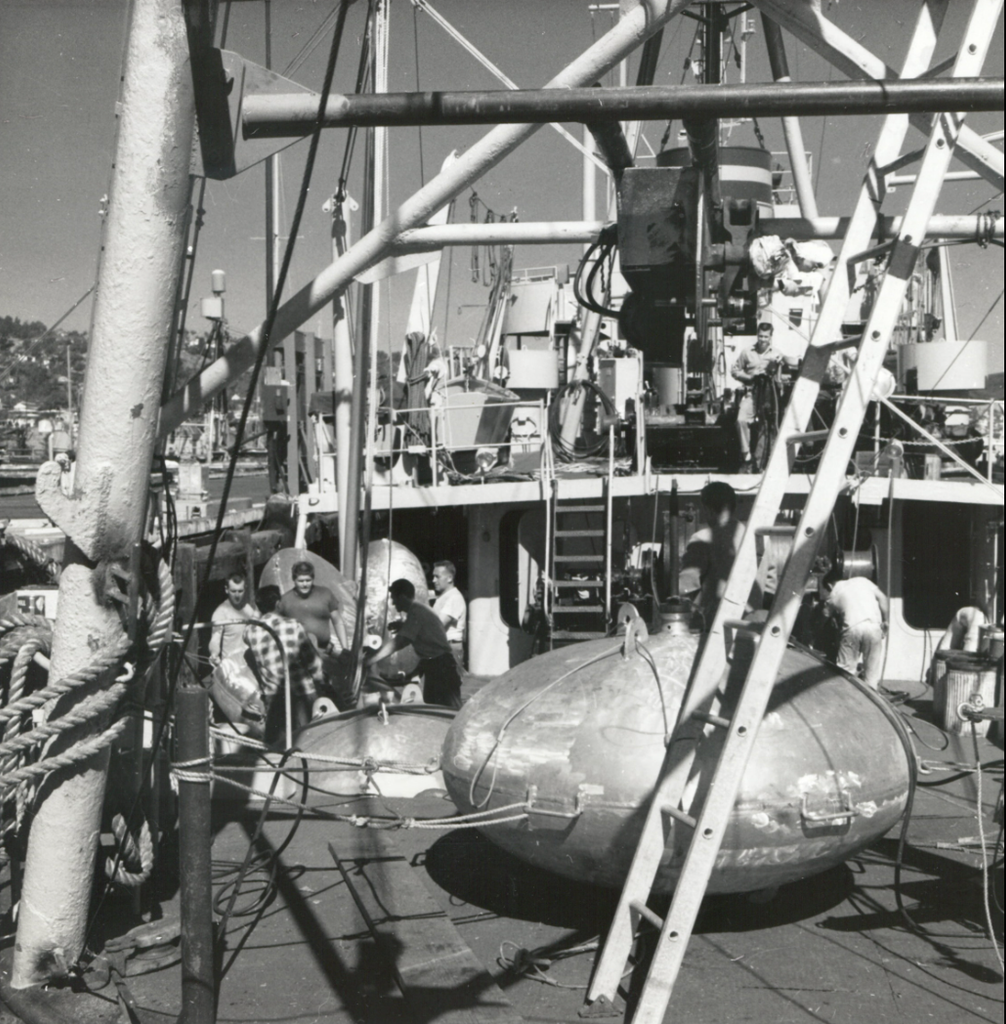
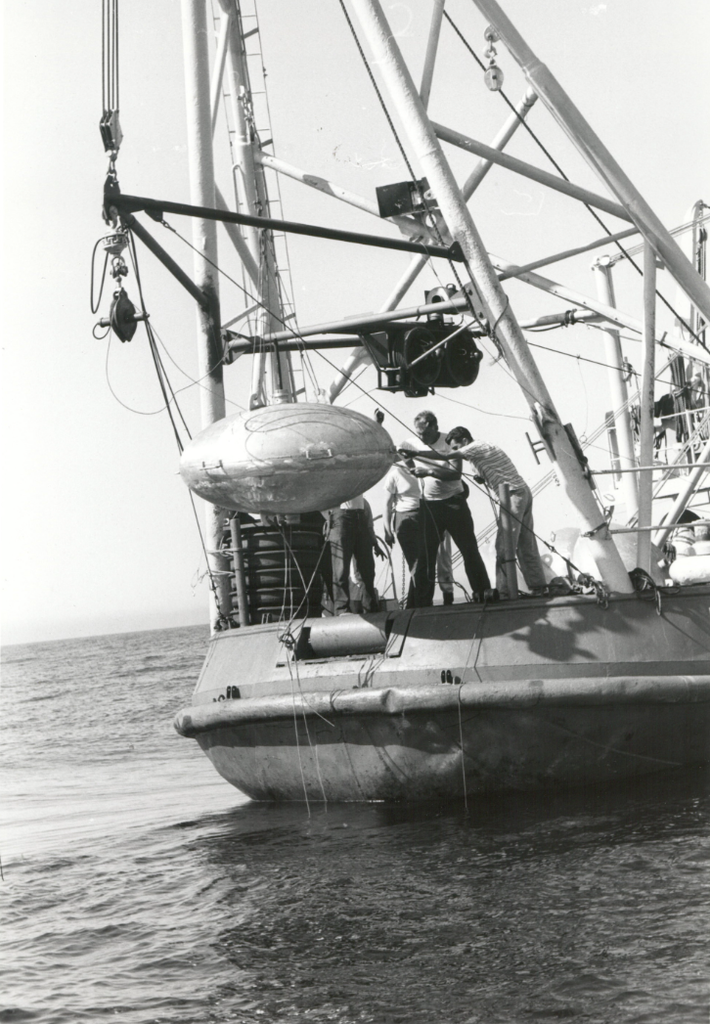
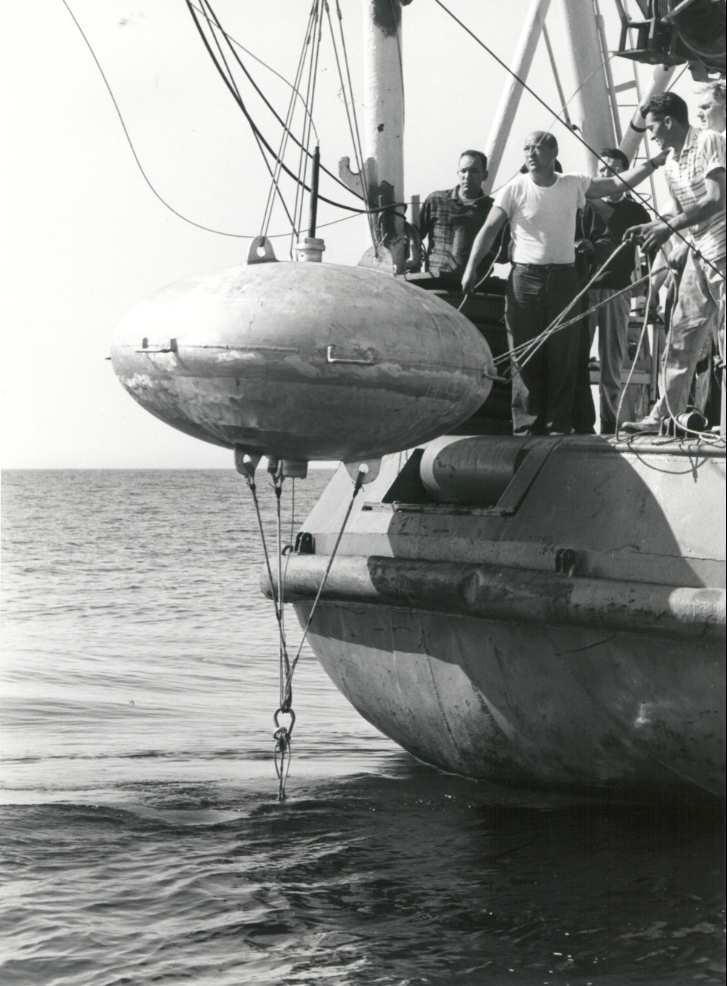
Steinbeck and Munk aboard CUSS I
Steinbeck was aboard CUSS I alongside Walter Munk, Roger Revelle, and other members of the scientific team. Steinbeck’s account appeared in the April 14, 1961 issue of LIFE magazine under the title “High Drama of Bold Thrust Through Ocean Floor.”
At a moment when America’s attention was increasingly focused on the space race, Steinbeck turned his attention in the opposite direction, toward the largely unexplored world beneath the ocean.
There is even a wonderfully Steinbeckian story from the expedition.
When the scientists recovered a prized piece of basalt from beneath the seafloor, Steinbeck wanted a piece as a souvenir. As he recounted in LIFE, he was refused and quietly pocketed a small fragment anyway. Then the chief scientist secretly gave him a piece. Feeling guilty about having already taken one, Steinbeck slipped the stolen fragment back.
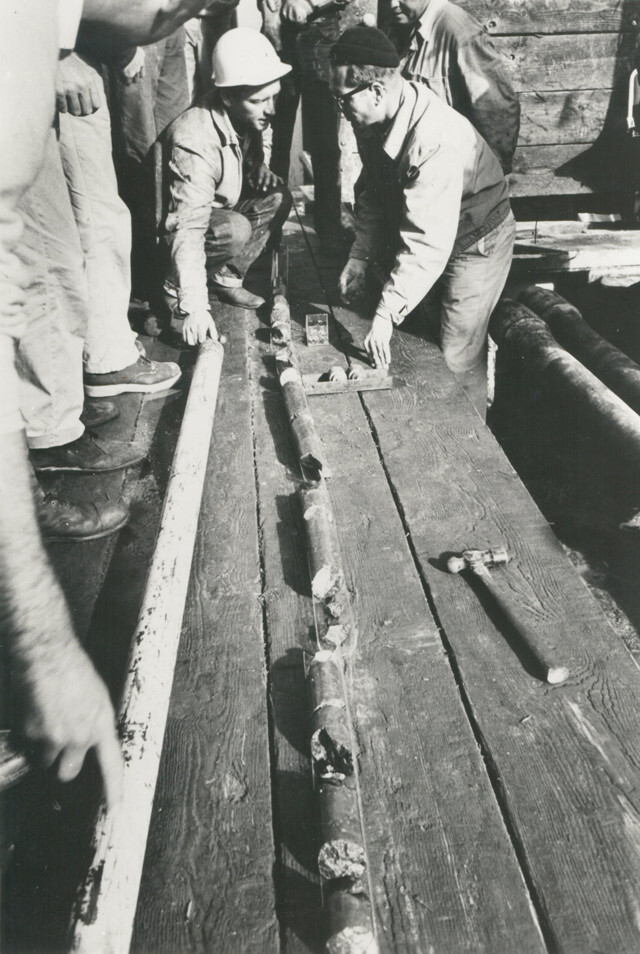
A familiar combination
There is something wonderfully familiar about finding Steinbeck aboard CUSS I, both in the nature of the expedition and in the way he wrote about it.
Once again, he was at sea with scientists. Once again, he was surrounded by people trying to understand something that couldn’t be understood without going out and looking for themselves. And once again, he used storytelling to bring that exploration to a much larger audience.
Steinbeck seemed particularly taken with the mix of people aboard CUSS I: drillers, engineers, oceanographers, geologists and geophysicists working side by side. “Our expedition should destroy the old and well loved error that doers and thinkers are different breeds—and about time too,” he wrote.
The people and ideas brought together through Project Mohole would have an impact far beyond that 1961 expedition. Walter Munk went on to a remarkable career at Scripps spanning more than seven decades, with work ranging from waves and tides to ocean circulation, acoustics, and Earth’s rotation.
Project Mohole would not ultimately reach the mantle, but its pioneering experiments demonstrated that deep-ocean scientific drilling was possible and helped pave the way for later ocean drilling programs that transformed our understanding of Earth’s history.
Which brings us back to Monterey.
More than six decades after Walter Munk and John Steinbeck stood together aboard CUSS I, Mary Munk stepped aboard the Western Flyer during OCEANS 2026. Her visit brought this remarkable connection back to life.
Today, Mary continues Walter’s legacy through the Walter Munk Foundation for the Oceans, which works to inspire ocean stewardship through science, education, and the arts—another connection that feels especially fitting.
The vessels, technologies and scientific questions may change, but the impulse behind them is remarkably familiar: go out, look closely, ask questions, and share what you discover.
Sources: Scripps Institution of Oceanography; Walter Munk Foundation for the Oceans; National Science Foundation; John Steinbeck, “High Drama of Bold Thrust Through Ocean Floor,” LIFE, April 14, 1961.
Written by Sherry Flumerfelt, Executive Director, Western Flyer Foundation
Publicado en Blog, Research