
This week, Western Flyer Foundation Board Member Jack Barth and advisor Adrián Munguía-Vega will be presenting results from our 2025 Gulf of California expedition at the PICES Small Pelagic Fish International Symposium in La Paz, Mexico.
During our return to the Gulf of California, the Western Flyer retraced part of the route first traveled by John Steinbeck and Ed Ricketts in 1940. That earlier expedition helped document the rich marine life of the Gulf. This time, instead of collecting intertidal specimens, we returned with new tools and new questions.
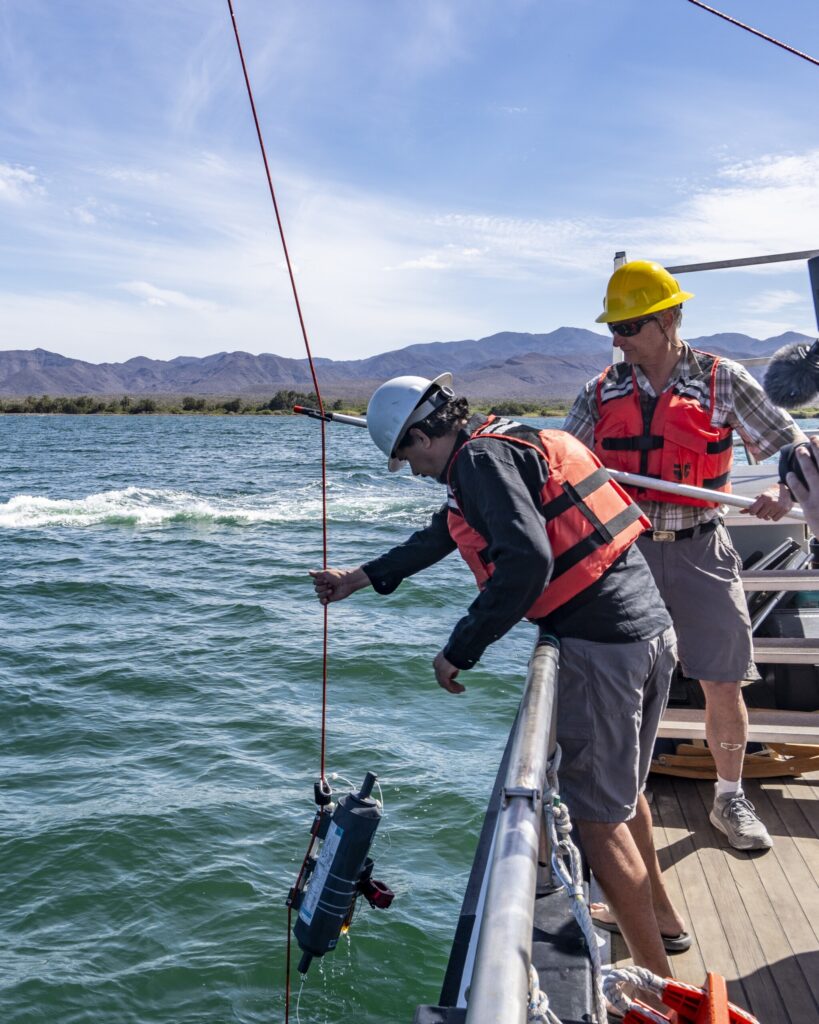
Working in partnership with Oregon State University, the University of Arizona, and the Applied Genomics Lab and Centro Interdisciplinario de Ciencias Marinas — part of Mexico’s Instituto Politécnico Nacional — in La Paz, the team collected ocean data and environmental DNA, or eDNA. Ocean properties were measured down to 500 m and included temperature, salinity, chlorophyll fluorescence, dissolved oxygen, and pH. The eDNA approach allows scientists to identify fish simply from traces of genetic material in the water.
The study spanned more than 500 kilometers of the Gulf. From just 18 samples, researchers identified over 50 families of fish, including small pelagic species like sardines and anchovies that are central to the marine food web and regional fisheries.
The results also show how closely fish are tied to their environment. Near the Midriff Islands, higher concentrations of fish were found at depth where oxygen and temperature conditions were more favorable.
Just as important is what is changing. Compared to data from 1970, oxygen levels in the Gulf are lower today, especially below about 50 meters. These shifts are linked to warming oceans and marine heat waves.
As conditions change, fish communities are likely shifting as well, with real implications for ecosystems and coastal communities.
This work reflects the ongoing role of the Western Flyer as a platform for science, carrying forward a legacy of exploration while helping us better understand a changing ocean.
Posted in Blog, Research